Chasing an unpaid placement fee is one of the less enjoyable parts of running a desk. You did the work, the candidate started, and now you're writing awkward emails to the same client you want to keep working with.
I've been in recruitment for more than 15 years, ten of them helping build one of the largest boutique search firms in its market, and I now run my own desk. When you work alone, a late fee affects your cash flow straight away, so it's worth having a process instead of hoping it sorts itself out.
This post covers why fees go unpaid, how to stop it happening, how to chase politely, and what to do when a client disputes the fee.
- Many unpaid recruitment fees are stuck in admin rather than refused. Often it's a missing PO number or an invoice sent to the wrong inbox
- The best time to prevent a late payment is before the offer goes out. Confirm the fee in writing and find out who pays invoices
- Chase early, chase in the same email thread, and start friendly. Your first message should assume an honest mistake
- Chase accounts payable for payment and your hiring manager for help. Don't make your contact feel like a debt collector's target
- Disputes usually come down to your terms of business. If they're signed and clear, most disputes settle quickly
- Escalate in steps, and only once you're ready to lose the client. Most of the time you won't have to
Why placement fees go unpaid
It helps to know what you're dealing with before you send the first chaser. In my experience, most late fees fall into one of these:
- The invoice never reached the right person. It went to the hiring manager, who forwarded it to nobody.
- Something was missing. No purchase order number, the wrong company name, the wrong address, or no supplier set-up on the client's system.
- Nobody approved it. Accounts payable is waiting for the hiring manager to sign it off, and the hiring manager doesn't know.
- The client is slow with everyone. Some companies pay late as a habit, or are short of cash.
- There's a disagreement. About the fee, the start date, the salary it was based on, or whether the candidate came from you at all.
- The candidate left early. The client wants a rebate or a replacement and is holding payment until it's sorted.
Only the last two are real disputes. The rest are admin, and admin is fixed with a polite email to the right person.
How to prevent late payment before the offer
The easiest late payment to deal with is the one that never happens. Most of the prevention happens before your candidate accepts.
- Get your terms of business signed before you send a CV. They should set out your fee, what it's calculated on, when you invoice, payment terms, your rebate or guarantee, and how long an introduction stays valid.
- Confirm the fee in writing at offer stage. A short email to your hiring manager when the offer goes out: the salary, the fee, the start date and when you'll invoice. It takes two minutes and removes most arguments later.
- Ask who pays invoices. Get the accounts payable email address, whether they need a purchase order, and whether you need to be set up as a supplier. Do it while everyone is happy about the hire.
- Put the due date somewhere you'll see it. On your own, nobody else will notice when an invoice goes past due.
An invoice that gets paid first time
A surprising number of chasers are caused by the invoice itself. Before you send one, check it has:
- the client's correct legal entity name and billing address
- their purchase order number, if they use them
- the candidate's name, role and start date
- the salary the fee is based on, and the fee percentage
- the payment terms and the due date
- your bank details, and any tax registration your market requires
- a reference to your signed terms of business
Send it to accounts payable and copy your hiring manager, so both know it exists. Raise it on the day your terms allow, usually acceptance or start date. Every day you wait is a day added to when you'll be paid.
How to chase unpaid invoices politely
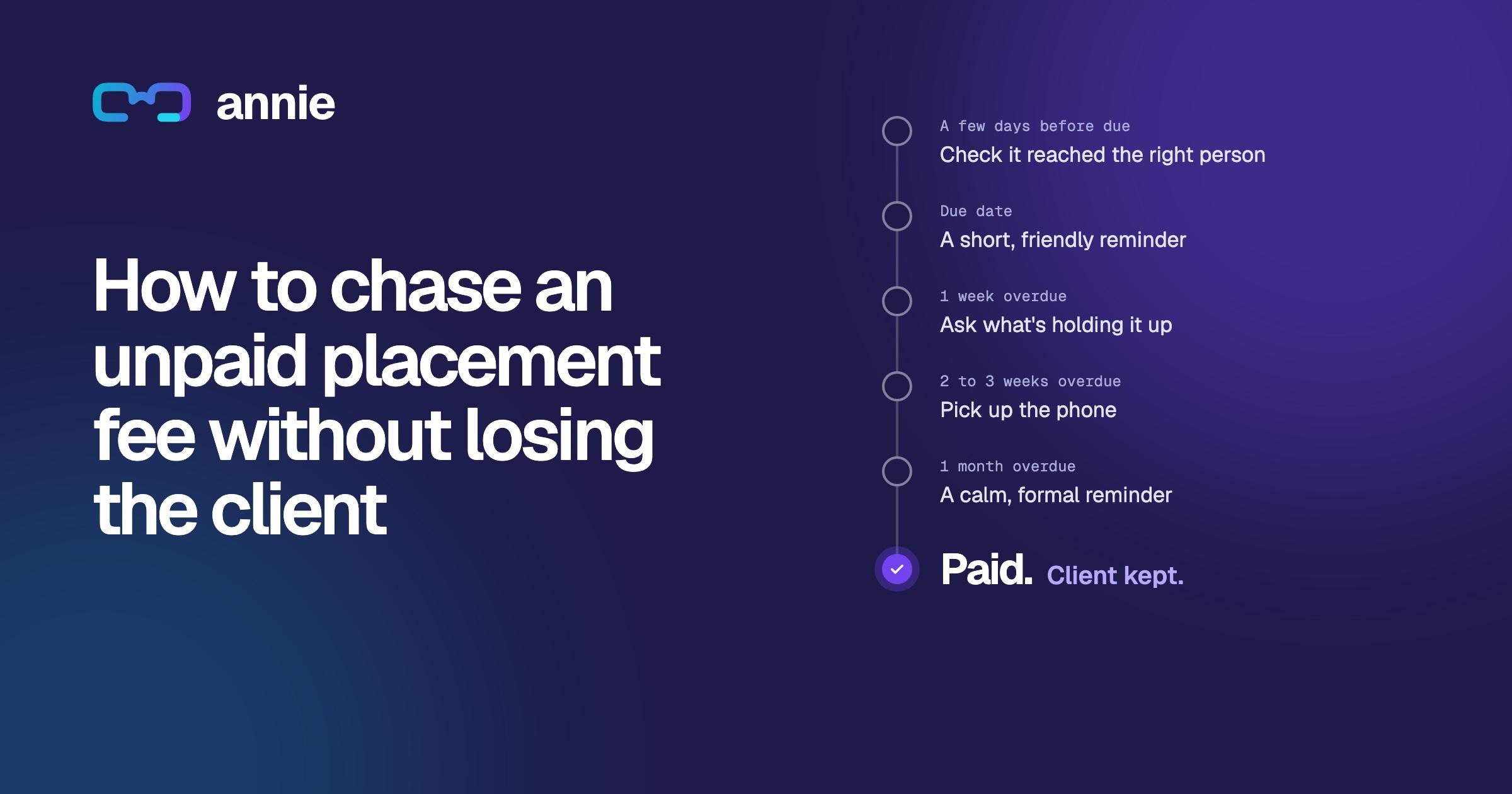
The aim is to get paid and still be the recruiter they call next time. Start friendly, stay in the same email thread, and get firmer in steps.
A few days before the due date
This is a check, not a chase. It catches most admin problems while there's still time.
Hi Sam, a quick check that invoice 0042 for Nadia's placement reached you and is set up for payment on 14 November. Let me know if you need anything else from me, such as a PO number or supplier details.
On the due date
Keep it short and neutral.
Hi Sam, invoice 0042 is due today. Could you let me know when payment is scheduled? I've attached a copy in case it's easier.
A week overdue
Ask a direct question that needs an answer.
Hi Sam, invoice 0042 is now a week overdue. Is there anything holding it up on your side? If it's waiting for approval, let me know who I should speak to and I'll take it from there.
This is also the time to send a short, friendly note to your hiring manager. It's not a demand, just a nudge.
Hi Sara, I hope Nadia's settling in well. Accounts are waiting on something before they can pay the invoice for her placement. Would you mind checking whether it's sitting with you for approval?
Two to three weeks overdue
Pick up the phone. Calls get answers that emails don't. Ask what's holding it up, agree a date, and confirm it by email straight after.
A month or more overdue
Now it's formal. Write a clear email that states the amount, the original due date, the days overdue and a firm date for payment, and refers to your terms of business. Stay polite. The tone that keeps the relationship is calm and factual, never angry.
Hi Sam, invoice 0042 for £18,000 was due on 14 November and is now 35 days overdue. Under our signed terms of business, payment was due within 30 days of the candidate's start date. Please arrange payment by 19 December. If there's an issue with the invoice, let me know this week so we can sort it out.
Who to chase, and who not to
Accounts payable pays the invoice. Your hiring manager is the relationship. Chase the first for payment, and ask the second for help only when something is stuck with them.
Try not to make your hiring manager feel like they're being chased for money. They didn't delay the payment, they just hired your candidate. Keep those messages short, warm and about solving a problem, and save anything firmer for accounts.
Handling placement fee disputes
When a client says they won't pay, find out exactly why before you respond. Most placement fee disputes are one of these.
“We already knew the candidate.”
This is the most common introduction fee dispute. Your terms should say what counts as an introduction and how long it stays valid. Check your records: when you sent the CV, whether the client acknowledged it, and whether they had a record of the candidate before you. Ask for evidence calmly. If they can show they were already talking to the candidate, accept it gracefully. If they can't, refer them to your terms.
“The candidate came through another agency.”
Compare dates. Usually whoever introduced the candidate first, in a way your terms define, is owed the fee. Clear records of when you sent the CV settle most of these.
“We hired them for a different role,” or “We hired them later.”
Good terms cover a client hiring your candidate into any role within a set period after your introduction. If yours do, say so politely.
“They left in the first few weeks.”
Check your rebate or replacement clause. Offer what your terms say, and do it quickly. A recruiter who handles an early leaver well often wins the replacement role.
“The fee is wrong.”
Check the salary it was calculated on and whether bonuses or benefits count. If you made a mistake, fix it straight away and send a corrected invoice.
Whatever the dispute, keep it in writing, keep it calm and keep it about your terms. If your terms weren't signed, you're negotiating rather than enforcing, so aim for a fair settlement over a perfect one.
Late payment interest and fees
In many places, businesses can charge interest on late payments between businesses, either because their contract says so or because the law allows it. Put a late payment interest clause in your terms of business so the client knows from the start.
Whether you actually charge it is a judgement call. Adding interest to a client you want to keep can end the relationship faster than the late payment did. I'd mention it in the formal reminder and use it as leverage, then decide based on the client.
When to escalate
If a month or two has passed, you've called, written formally and still have no payment or no reason, it's time to decide whether you want the money or the client more. Sometimes you can't have both.
The usual steps are:
- A formal letter before action, setting out the debt and a final deadline, and saying what you'll do if it isn't paid.
- A debt collection agency or a lawyer, who will send their own demand. Many clients pay at this point.
- A court claim, using the small claims or fast-track process where you are. Get legal advice first.
Often it doesn't come to that. A calm, clear letter that refers to signed terms is a strong nudge.
Keeping the client once you've been paid
When the money lands, thank them. A short, warm email that confirms payment and says you're looking forward to the next role resets the tone.
Then fix whatever caused the delay. If they need a PO number, ask for it at offer stage next time. If they're slow with every supplier, shorten your payment terms or ask for part of the fee upfront on their next role. And if a client is slow every single time, it's fair to ask whether they're worth the chasing.
Where Annie fits
Most of what's in this post comes down to not losing track: raising the invoice on time, knowing when it's due and noticing when it isn't paid. I built Annie so that part doesn't depend on my memory.
You raise the invoice straight from the placement, with the client, fee, currency, tax, payment terms and guarantee filled in, and send it from your own mailbox. Annie reminds you before it's due, and when it's late she drafts the chase in the same email thread for you to read and send. She also flags a placement with no invoice yet, counts down the guarantee period with your rebate steps, and drafts a thank-you with a paid copy once the money lands.
It sits alongside your contacts, candidates, jobs and BD pipeline, so the client you're chasing is the same record you'll call about the next role. Solo is $129 a month with everything included and no contract. See pricing.
Try it on your own desk for 10 days, no credit card needed. Or book a call with me and bring the invoice you're chasing.
Questions
How do I chase an unpaid recruitment fee?
Check the invoice reached the right person a few days before it's due. Send a short reminder on the due date, ask what's holding it up a week later, call after two to three weeks, and send a formal reminder referring to your terms of business after a month. Keep every message polite and in the same email thread.
How do you chase payment politely?
Assume an honest mistake in your first message, keep it short, and make it easy to pay by attaching the invoice and offering any missing details. Ask a direct question, such as when payment is scheduled, so the reply has to be more than "noted". Get firmer in steps, but stay calm and factual.
What should I do if a client disputes a recruitment fee?
Find out exactly why. Check your signed terms of business and your records of when you introduced the candidate. Respond in writing, calmly, with the facts. If the client has a fair point, settle it quickly. If they don't, refer them to the terms they signed.
What is a recruitment introduction fee dispute?
It's a disagreement over whether a recruiter introduced the candidate who was hired, and so whether a fee is owed. Common examples are a client saying they already knew the candidate, or that another agency introduced them first. Clear terms that define an introduction and how long it stays valid settle most of these.
Can a recruiter charge interest on a late placement fee?
In many places, yes, either under a late payment clause in your terms of business or under local law on late payments between businesses. Check what applies where you and your client are, and include the clause in your terms so the client knows from the start.
Do I have to refund a placement fee if the candidate leaves?
Only if your terms of business say so. Most recruiters offer either a partial rebate or a free replacement if the candidate leaves within a set guarantee period. If your terms don't include one, you aren't obliged to, but handling an early leaver fairly often keeps the client.
When should I take legal action over an unpaid fee?
When you've chased in writing and by phone, sent a formal letter before action with a final deadline, and still have no payment or reason. Get legal advice first, and decide whether recovering the fee is worth losing the client.

Michael Stubbs has spent more than 15 years in recruitment, ten of them helping build one of the largest boutique search firms in its market. He now runs his own desk and is the founder of Annie, the recruitment CRM that tells you who to call. He is also the founder of Vantage Search Group, a research-led executive search firm.