Most guides on how to start a recruitment agency read like a company registration form with a stock photo on top. Register the business, open a bank account, build a website, done. All true, and none of it is why new agencies struggle.
I've been in recruitment for more than 15 years. I spent ten of them helping build one of the largest boutique search firms in its market, and now I run my own desk. The paperwork is the quick part. The things that decide whether you're still trading in two years take a lot longer to learn.
So this is the guide I'd have wanted before going solo. It covers the steps, the money, the contract you signed years ago and forgot about, where your first clients come from, and the mistakes I'd warn my younger self about.
- Starting a recruitment agency is cheap. Keeping one going is the hard part, because the gap between your first call and your first paid invoice can run to months
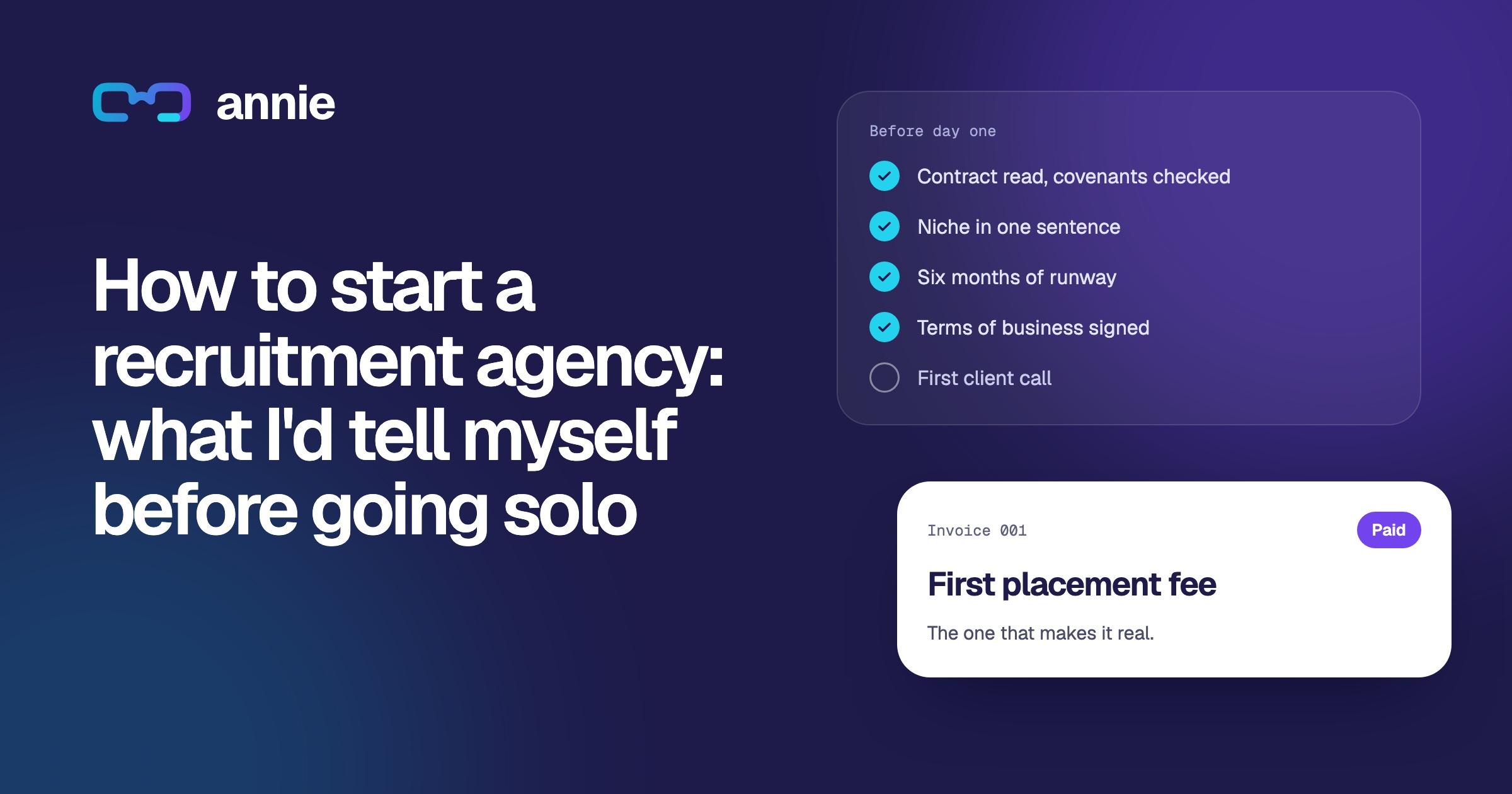
- Before you resign, read your contract for restrictive covenants, and take nothing from your old employer's database
- Pick a niche you can explain in one sentence, and choose your model (contingent, retained or contract) before you spend a penny
- Set up the basics: a company, a bank account, an accountant, the right insurance and terms of business that protect your fee
- Your first clients will come from people who already know you. Business development is the job, even when you're busy filling roles
- Keep your tools simple: a CRM, your email, LinkedIn and a one-page website will do for year one
Should you start a recruitment agency at all?
Before you think about logos, answer four questions honestly.
- Would at least two or three clients work with you on day one? Not “would probably take a call”. Would they brief you a role.
- Can you live without a placement fee for six months? Fees arrive late. A role you win this month may not be filled, started and paid for until well into next quarter.
- Do you like business development? In a firm, someone else may bring in some of the work. On your own, winning clients is the job, every week, including the weeks you're busy.
- Is your contract clean? More on this in step one, but if your old employer can stop you calling your clients for a year, your plan needs to change.
If you answered yes to all four, keep reading. If not, it doesn't mean don't do it. It means fix those first.
How to start a recruitment agency in 10 steps
1. Read your contract before you resign
Most recruitment contracts have restrictive covenants: clauses that limit who you can approach, and for how long, after you leave. Some stop you dealing with clients you worked with. Some stop you approaching candidates or poaching staff. Read yours properly and, if there's any doubt, pay an employment lawyer for an hour. It's the cheapest insurance you'll buy.
And take nothing with you. Your old employer's database, CV files and client lists belong to them, and copying them is a quick way to start your new business with a legal letter. Your network is yours. Their spreadsheet isn't.
2. Pick a niche you can explain in one sentence
“I place senior finance people in mid-sized logistics companies” wins more work than “I recruit across sectors”. A clear niche tells clients why they should call you over a firm with 200 consultants, and it tells you who to call on Monday. Start with the market where people already know your name.
3. Choose your model
There are three common ways to get paid, and they change how much money you need.
- Contingent: you're paid only when your candidate is hired. Fees for permanent roles are usually a percentage of the candidate's first-year salary, commonly around 20 to 25 percent. Low barrier, but you often compete with other agencies on the same role.
- Retained: the client pays part of the fee upfront, usually in stages. Executive search commonly charges around a third of first-year pay. It suits senior roles and recruiters with a track record.
- Contract or temporary staffing: you place people on contracts and bill the client for their time, usually weekly or monthly. It brings recurring income, but you often pay the contractor before the client pays you, so you'll need funding to cover the gap.
Most solo recruiters start with contingent permanent roles and add retained work as their reputation grows.
4. Work out your runway
Add up your living costs, your business costs and a buffer, and make sure you can cover six months without a fee. Then assume your first placement will take longer than you think. Running out of money is how a lot of good recruiters end up back in a job.
5. Set up the business
This is the part every other guide covers, and it's the quickest.
- Register the business in the structure your accountant recommends.
- Open a business bank account, and keep your money separate from day one.
- Find an accountant who works with recruiters. They'll save you more than they cost.
- Check whether you need a licence. Some countries require a licence to run a recruitment agency. Others don't, but have rules on how agencies must operate, such as not charging candidates for finding them work. Check the rules wherever you're registered and wherever you place people.
- Get the right insurance. Professional indemnity insurance covers you if a client says your advice or your candidate cost them money, and it's the one most clients ask about. You may also need public liability cover, and employer's liability once you take on staff. A broker who knows recruitment can tell you what your market expects.
- Register for data protection where the law requires it, and write a privacy notice. You'll be holding a lot of personal data about candidates.
6. Write your terms of business before your first CV goes out
Your terms of business are the contract between you and your client. Without them, you're relying on goodwill to get paid. At minimum, cover:
- your fee and what it's calculated on
- when the invoice is raised and when it's due
- your rebate or guarantee if a candidate leaves early
- how long an introduction stays valid, so a client can't hire your candidate six months later without paying
- what happens if the client passes your candidate to someone else
Get a lawyer to check your first version. Then send it, and get it signed, before you send a single CV.
7. Set up your tools, and stop there
In year one you need very little.
- A recruitment CRM to track clients, candidates, jobs and follow-ups. If you're wondering whether a spreadsheet will do, I wrote about that in Do solo recruiters need a CRM, or will a spreadsheet do?
- A professional email address on your own domain.
- LinkedIn, which is your shop window and your sourcing tool.
- A one-page website that says who you place, where, and how to get in touch.
Job board subscriptions, paid sourcing tools and a big website can wait until a client is paying for them. If you're curious about AI tools, start with the ones that save you admin. I covered which are worth it in AI in recruitment: what's worth using if you run a small desk.
8. Win your first clients from people who already know you
Your first clients almost always come from your existing network: hiring managers you've placed with, candidates you placed who now hire, and people who've seen your work. Start there.
- Make a list of everyone who has hired through you or worked with you. Call them, don't just email.
- Watch for reasons to call: a new senior appointment, a funding round, an expansion or a new job posted.
- Tell people what you're doing and what kind of role you'd like to work on. Be specific.
A LinkedIn post announcing your new agency will get you congratulations. Phone calls get you roles.
9. Fill fewer roles, properly
It's tempting to say yes to every brief. Don't. Three roles you can fill beat ten you can't, and a client who sees you fill their first role quickly is a client for years. Qualify every job: why is it open, what's the budget, who decides, and how fast can they interview?
10. Invoice on time and chase what you're owed
Raise the invoice the moment your terms allow, usually on acceptance or start date. Put the due date and the guarantee end date somewhere you'll see them. A late fee hurts more when you're on your own, and an awkward chase gets more awkward the longer you leave it.
Can you start one with no experience?
You can, but I wouldn't recommend it. Without a track record you don't have the two things that make a new agency work: a network that trusts you and the judgement to know which roles are worth taking. If you're new to recruitment, spend a few years in a good agency first. You'll learn the job on someone else's money, and you'll build the network you'll eventually take with you, within whatever your contract allows.
If you're set on starting now, pick a niche where you already know the industry from the inside, and look for a mentor who has run a desk.
Can you run a recruitment agency from home?
Yes. Most of the job is calls, video interviews and email. Clients care whether you fill their roles, not where your desk is. Rent an office when you hire your first person or when you need somewhere to meet clients regularly. Until then, it's money better spent on runway.
Your first 90 days
Days 1 to 30: company set up, insurance in place, terms of business written, CRM and email running. Call every person on your list. Aim to have your first roles briefed by the end of the month.
Days 31 to 60: work those roles hard and keep business development going every morning, even when you're busy. Send your first shortlists. Ask every client what else they're hiring for.
Days 61 to 90: first offers, first invoices. Look at where your roles came from and do more of that. Drop anything that took time and gave you nothing.
What I'd tell myself before going solo
These are the mistakes I see most often in new agencies.
- Don't stop business development when you're busy. It's the most common trap. You win three roles, spend a month filling them, and then there's nothing behind them. Do some BD every day, even if it's only five calls.
- Don't discount your fee to win work. A client who chose you because you were cheapest will leave for someone cheaper.
- Don't work without signed terms. Every recruiter has a story about the client who “never agreed” to the fee.
- Don't build the brand before you have the business. A perfect logo won't get a hiring manager to call you back.
- Don't go too broad. “I recruit anything” means nobody thinks of you for anything.
- Write things down. On your own there's nobody to remember who said “call me in March”. If it isn't in your system, it won't happen.
- Look after yourself. Running a desk alone can be lonely. Find other independent recruiters to talk to. Most are happy to share what they've learned.
Where Annie fits
I built Annie for the recruiter I was when I went solo: a good network, too many things to remember and nobody else on the desk.
Every morning at 09:00 she sends a short list of people worth calling today, with the reason for each name: a new role posted, a leadership change, a reply you owe or a client who's gone quiet. Contacts, candidates, jobs, a BD pipeline and invoices sit in one place, so the business development doesn't stop when you're busy filling roles. Drafts open in your own Gmail or Outlook, and nothing goes out until you press send.
Setup takes about 15 minutes with your LinkedIn export and your inbox. Solo is $129 a month with everything included and no contract. See pricing.
If you're about to go solo, or you already have, try it on your own network for 10 days, no credit card needed. Or book a call with me. I'm happy to talk through your plan, whether or not you use Annie.
Questions
How do I start a recruitment agency?
To start a recruitment agency, check your current contract for restrictive covenants, pick a niche, choose a fee model, register the business, get insurance, write your terms of business, set up a CRM and email, then win your first clients from your existing network. Plan for at least six months without a placement fee.
How much does it cost to start a recruitment agency?
The set-up costs are low compared with most businesses: company registration, insurance, an accountant, a CRM, email, a website and LinkedIn. The bigger cost is living without income while you win and fill your first roles, so budget for at least six months of personal and business costs.
Do I need a licence to start a recruitment agency?
It depends on the country. Some require a licence to run a recruitment or employment agency, while others don't but set rules on how agencies operate, such as banning fees to candidates for finding them work. Check the rules where your business is registered and where you place people.
What insurance do I need to start a recruitment agency?
Most new agencies start with professional indemnity insurance, which covers claims that your advice or service caused a client a loss. Many also take public liability cover, and employer's liability once they take on staff. A broker who specialises in recruitment can tell you what clients in your market expect.
How much do recruitment agencies charge?
Permanent placement fees are usually a percentage of the candidate's first-year salary. Contingent fees commonly sit around 20 to 25 percent, and retained executive search around a third of first-year pay. Fees vary by market, seniority and how hard the role is to fill.
How long does it take to make your first placement?
It varies, but plan for months rather than weeks. You need to win the role, find and interview candidates, get through the client's interviews and an offer, and then wait for the candidate to start and the invoice to be paid.
Can I start a recruitment agency with no money?
You can start with very little, because the main tools are a phone, a laptop and your network. What you can't do is go without income for long, so keep your costs low and have enough savings to cover the months before your first fee.
Is a staffing agency the same as a recruitment agency?
Largely, yes. "Staffing agency" is the more common term in the US, and it often refers to temporary and contract placements. "Recruitment agency" is more common in the UK and elsewhere and covers both permanent and contract recruitment. The steps to start one are the same.
Is starting a recruitment agency worth it?
It can be. You keep the full fee instead of a commission split, and you choose your clients. In return you carry the risk, the admin and the business development. It suits recruiters with a strong network who enjoy winning work as much as filling it.

Michael Stubbs has spent more than 15 years in recruitment, ten of them helping build one of the largest boutique search firms in its market. He now runs his own desk and is the founder of Annie, the recruitment CRM that tells you who to call. He is also the founder of Vantage Search Group, a research-led executive search firm.