If you search for recruitment KPIs, most of what comes back is written for in-house HR teams. It covers cost per hire, time to hire and offer acceptance from the employer's side. Those numbers matter to your clients, but they don't tell you whether your agency is healthy.
In my experience the numbers I watch are simpler: what we billed, what we collected, how our pipeline is converting and whether we're doing enough business development to keep it full.
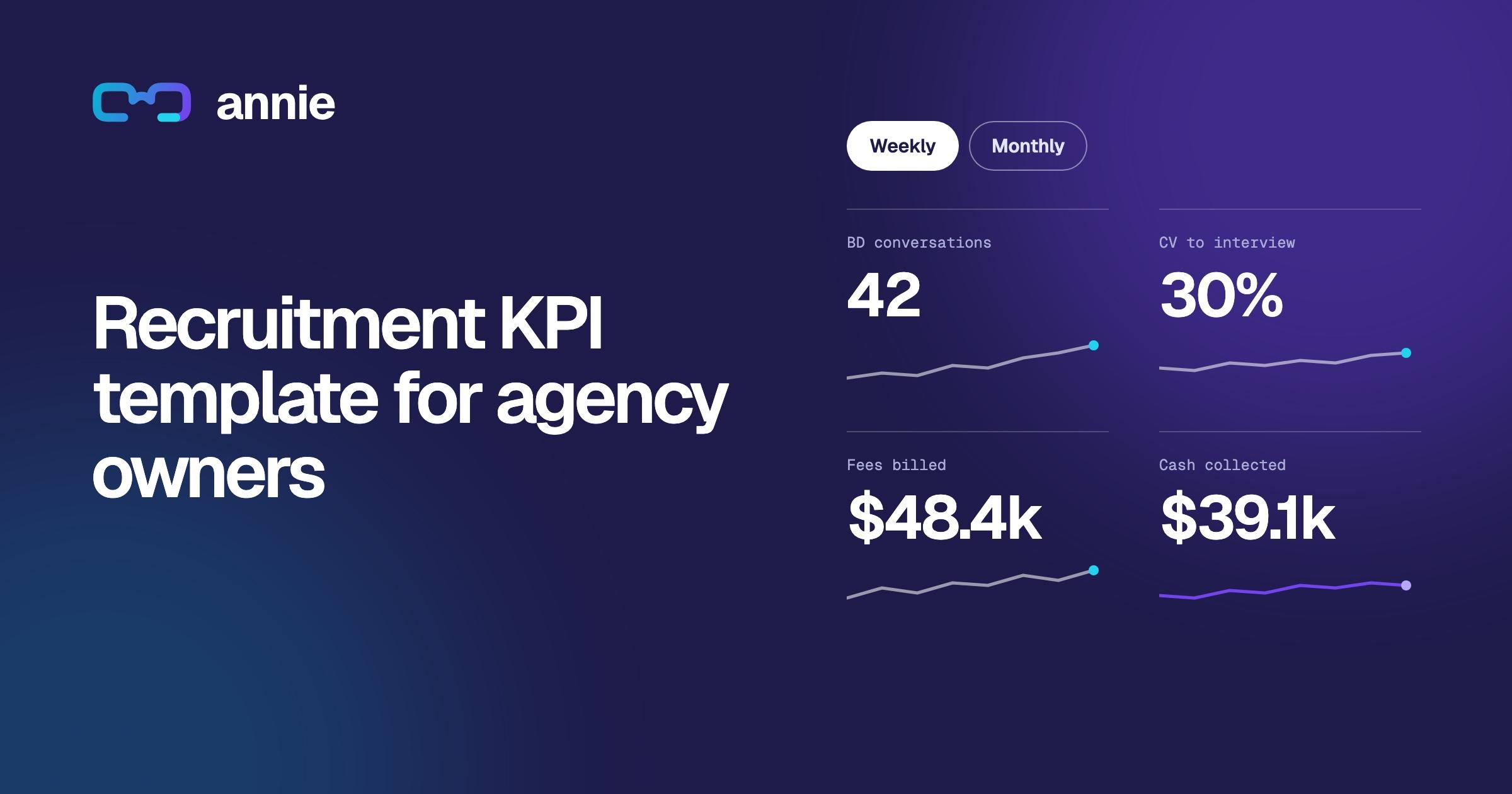
This post sets out a recruitment KPI template for agency owners, with a weekly view and a monthly view, how to calculate each number, and how to tell when one needs your attention.
- Most recruitment KPI guides are written for in-house HR teams. An agency needs a different set: fees, cash, conversion ratios and business development
- Track a short weekly view of activity and pipeline, and a monthly view of money and ratios. Eight weekly numbers and twelve monthly ones are enough
- Weekly: BD conversations, new roles briefed, CVs sent, first interviews, offers, placements, invoices raised and cash collected
- Monthly: fees billed, cash collected, average fee, the three conversion ratios, fill rate, time to fill, new clients, client concentration and overdue invoices
- Don't copy someone else's benchmarks. Track your own numbers for three months and compare yourself with that
- A KPI only matters if it changes what you do on Monday
Why agency KPIs differ from in-house metrics
An in-house talent team is a cost centre. Its KPIs ask how quickly and cheaply the company hired. An agency is a business that sells placements, so its KPIs need to answer different questions:
- Are we doing enough of the work that leads to fees?
- Is that work turning into placements?
- Are placements turning into cash in the bank?
- Are we relying too much on one client or one consultant?
The template below answers those four questions, and nothing else. If a number doesn't help with one of them, I leave it out.
The weekly view: activity and pipeline
The weekly view is about effort and momentum. It's the numbers you can still change this week. Count each one per consultant if you have a team, and in total.
| KPI | What it counts | |
|---|---|---|
| 1 | BD conversations | Calls and meetings with hiring managers about current or future roles. Not emails sent, conversations had. |
| 2 | New roles briefed | Jobs you've taken a proper brief on, with terms agreed. |
| 3 | CVs sent | Candidates submitted to clients. |
| 4 | First interviews | Candidates who had a first interview with a client. |
| 5 | Offers | Offers made to your candidates. |
| 6 | Placements | Offers accepted. |
| 7 | Invoices raised | The number and the total value. |
| 8 | Cash collected | Money that actually arrived. |
Set it up as one row per KPI and one column per week. After a month you'll see patterns that one week never shows.
The monthly view: money and ratios
The monthly view is about results and health. These numbers move slowly, so weekly tracking just adds noise.
| Group | KPI | What it counts | |
|---|---|---|---|
| 1 | Money | Fees billed | The total value of invoices raised in the month. |
| 2 | Money | Cash collected | The total paid into your account in the month. |
| 3 | Money | Average fee | Fees billed divided by placements. |
| 4 | Money | Overdue invoices | The number and value of invoices past their due date. |
| 5 | Ratios | CV to interview | First interviews divided by CVs sent. |
| 6 | Ratios | Interview to offer | Offers divided by first interviews. |
| 7 | Ratios | Offer to acceptance | Placements divided by offers. |
| 8 | Ratios | Fill rate | Roles filled divided by roles you worked on. |
| 9 | Ratios | Time to fill | The average number of days from brief to accepted offer. |
| 10 | Business health | New clients | Clients you placed with for the first time. |
| 11 | Business health | Client concentration | The share of the month's fees that came from your biggest client. |
| 12 | Business health | Early leavers | Candidates who left within your guarantee period, and any rebates paid. |
Twelve monthly numbers and eight weekly ones. That's the whole template.
How to calculate each recruitment KPI
Most of these are simple counts. The ones people get wrong are the ratios, so here they are written out.
- CV to interview ratio = first interviews ÷ CVs sent. If you sent 20 CVs and 6 got a first interview, that's 30%.
- Interview to offer ratio = offers ÷ first interviews. 6 first interviews and 2 offers is 33%.
- Offer to acceptance ratio = placements ÷ offers. 2 offers and 2 acceptances is 100%.
- Fill rate = roles filled ÷ roles worked. Count a role as worked once you've sent at least one CV.
- Average fee = fees billed ÷ placements.
- Time to fill = days from brief to accepted offer, averaged across the roles filled that month.
- Client concentration = fees from your largest client ÷ total fees billed.
- Collection gap = fees billed minus cash collected over the same three months. A growing gap means cash is getting stuck.
Use the same definitions every month. A ratio that changes definition halfway through the year tells you nothing.
How to read your numbers
The numbers only help if you know what to do when one moves. These are the patterns I'd look for.
Lots of BD conversations, few new roles: You're talking to the wrong people or not asking for the work. Look at who you're calling and what you're saying.
Plenty of roles, few CVs sent: You've taken on more than you can deliver, or the roles are hard to fill. Qualify harder before you accept a brief.
Low CV to interview ratio: Your shortlists don't match what the client wants. Go back to the brief, or ask the client for feedback on the CVs they rejected.
Good interview numbers, few offers: Candidates aren't being prepared well, or the client keeps changing what they want. Debrief both sides after every interview.
Offers turned down: Usually money, a counter-offer or a poor process. Ask early what the candidate needs to accept, and test it before the offer goes out.
Fees billed rising, cash collected flat: Clients are paying late. Look at your overdue list this week, not at month end.
One client above a third of your fees: That's a risk, not just a success. Use the good months to win new clients rather than leaning harder on the big one.
As for benchmarks: I'd be careful copying other people's ratios. They vary a lot by market, seniority and whether you work contingent or retained. Track your own numbers for three months, use that as your baseline, and aim to beat yourself.
Setting up your recruitment dashboard
You don't need special software to start. A spreadsheet with two tabs, weekly and monthly, will do. What matters is that the numbers get filled in every week without it becoming a chore.
- Pick a time: Friday afternoon or Monday morning, the same slot every week.
- Pull from your system, not your memory: If your CRM can count CVs sent and interviews for you, use it. Typing numbers from memory is how dashboards end up fiction.
- Show trends, not single weeks: A line or bar for each KPI over the last 12 weeks tells you far more than this week's figure.
- Keep it to one page: If you have to scroll, you have too many numbers.
- Review it with your team: Five minutes a week, per consultant. Ask what they'll do differently, not why the number is low.
If you're still running the whole desk from a spreadsheet, I wrote about when that stops working in Do solo recruiters need a CRM, or will a spreadsheet do?
Mistakes agency owners make with KPIs
- Measuring activity for its own sake: Calls made means little on its own. Conversations that led to a brief mean a lot more.
- Tracking too many numbers: If nobody acts on a KPI, delete it.
- Counting fees, not cash: Billings feel good. Cash pays salaries.
- Using KPIs to blame people: Consultants will start gaming the numbers, and then the numbers are useless.
- Changing definitions: Decide what counts as a CV sent or a role worked, write it down and stick to it.
- Looking only at the month just gone: Most of the warning signs show up in the weekly pipeline a month or two before they show up in fees. If business development drops this month, billings usually drop later. I wrote about getting it moving again in Recruitment business development when your client list runs dry.
Where Annie fits
The hardest part of any KPI template is filling it in honestly every week. I built Annie so the numbers come from the work itself rather than from memory on a Friday afternoon.
Calls, emails and meetings are logged as you go, and your inbox files a note against the right contact. Candidates move through shortlisted, interviewing, at offer and placed, and placements turn into invoices that are tracked from draft to paid. The Performance page then shows your activity, pipeline conversion, fees invoiced against fees paid, and fees by client for this month, last month, the quarter or the last 12 months. You can also ask Annie a question about your desk from the box at the top of every page.
Solo is $129 a month with everything included and no contract, and there's a plan for teams of 2 to 10 where every recruiter gets their own desk. See pricing.
Try it on your own desk for 10 days, no credit card needed. Or book a call with me and we can look at which numbers matter most for your agency.
Questions
What are the KPIs in recruitment?
For a recruitment agency, the main KPIs are business development conversations, new roles briefed, CVs sent, interviews, offers, placements, fees billed and cash collected, plus conversion ratios such as CV to interview, interview to offer and offer to acceptance. In-house teams track different ones, such as cost per hire and time to hire.
What KPIs should a recruitment agency owner track?
Track a weekly view of activity and pipeline (BD conversations, roles briefed, CVs sent, interviews, offers, placements, invoices and cash) and a monthly view of money and ratios (fees billed, cash collected, average fee, overdue invoices, conversion ratios, fill rate, time to fill, new clients, client concentration and early leavers).
What is a recruitment KPI template?
A recruitment KPI template is a ready-made sheet or dashboard that lists the numbers to track, how often, and how each one is calculated. A simple version has two tabs: a weekly view with one column per week, and a monthly view with one column per month.
What should a recruitment dashboard show?
A recruitment dashboard should show the trend of each key number over time, not just the latest figure. For an agency, that means activity and pipeline each week, and fees, cash, conversion ratios and client concentration each month, all on one page.
How do you calculate the CV to interview ratio?
Divide the number of first interviews by the number of CVs sent in the same period. If you sent 20 CVs and 6 led to a first interview, your CV to interview ratio is 30%.
What is a good fill rate for a recruitment agency?
It depends on your market, the seniority of the roles and whether you work contingent or retained. Rather than chasing someone else's benchmark, track your own fill rate for three months and use it as your baseline.
What is the difference between recruitment KPIs and recruitment metrics?
Metrics are any numbers you can measure. KPIs are the few metrics you've chosen because they show whether the business is on track. Most agencies measure far more than they need and act on far less.

Michael Stubbs has spent more than 15 years in recruitment, ten of them helping build one of the largest boutique search firms in its market. He now runs his own desk and is the founder of Annie, the recruitment CRM that tells you who to call. He is also the founder of Vantage Search Group, a research-led executive search firm.