Search runs on long relationships
Retained search is a small number of big assignments. Each one is paid for in stages and runs for months. Each one comes from someone who trusted you enough to hand over a senior hire.
That trust takes years to build. The finance director you placed becomes the CEO who briefs you later. The candidate you turned down kindly calls you when she's hiring her own leadership team.
So a search founder's real asset is the network, and the hardest part of the job is timing. You want to call the chair the week the new CEO starts, not a quarter later when the board has already picked another firm.
What executive search software needs to hold
- Mandates. Each search as its own job, with a pipeline from long list to shortlist to placement.
- Candidates. Every CV, report and document on each person, kept on their record.
- Your own terms. Custom fields for whatever you track on a mandate, such as retainer stages, exclusivity or the fee basis.
- Clients and the people inside them. One timeline per contact of calls, meetings, notes and stage moves, with your Gmail or Outlook emails filed on the right person.
- A client-facing shortlist. A view-only link you can send to the client, without exporting anything.
- Placements and invoices. Raise each invoice and email it to your client from Annie.
For how a recruitment CRM works in general, read our recruitment CRM guide.
Where the next mandate comes from
Senior hiring rarely starts with an advert. It starts with a change at the top. Annie watches the companies where you know someone, and puts each change on the person you know inside:
- A new appointment. A new CEO or group leader often reshapes the team under them.
- A funding round. New money tends to bring board appointments and senior hires with it.
- An expansion. A new market or office needs someone to run it.
- A live role on the company's own careers page. A senior role posted with no agency named can be a search they're trying to run themselves.
Every signal links to its source, so you can read it before you pick up the phone. If the person you know has gone quiet, Annie shows you other ways into the same company.
Your own network gets read as well. Re-import your LinkedIn connections, and Annie shows you who has changed job since your last file. She flags past clients worth a call again, senior people you know but have never called, and replies you never answered.
A morning with Annie (worked example)
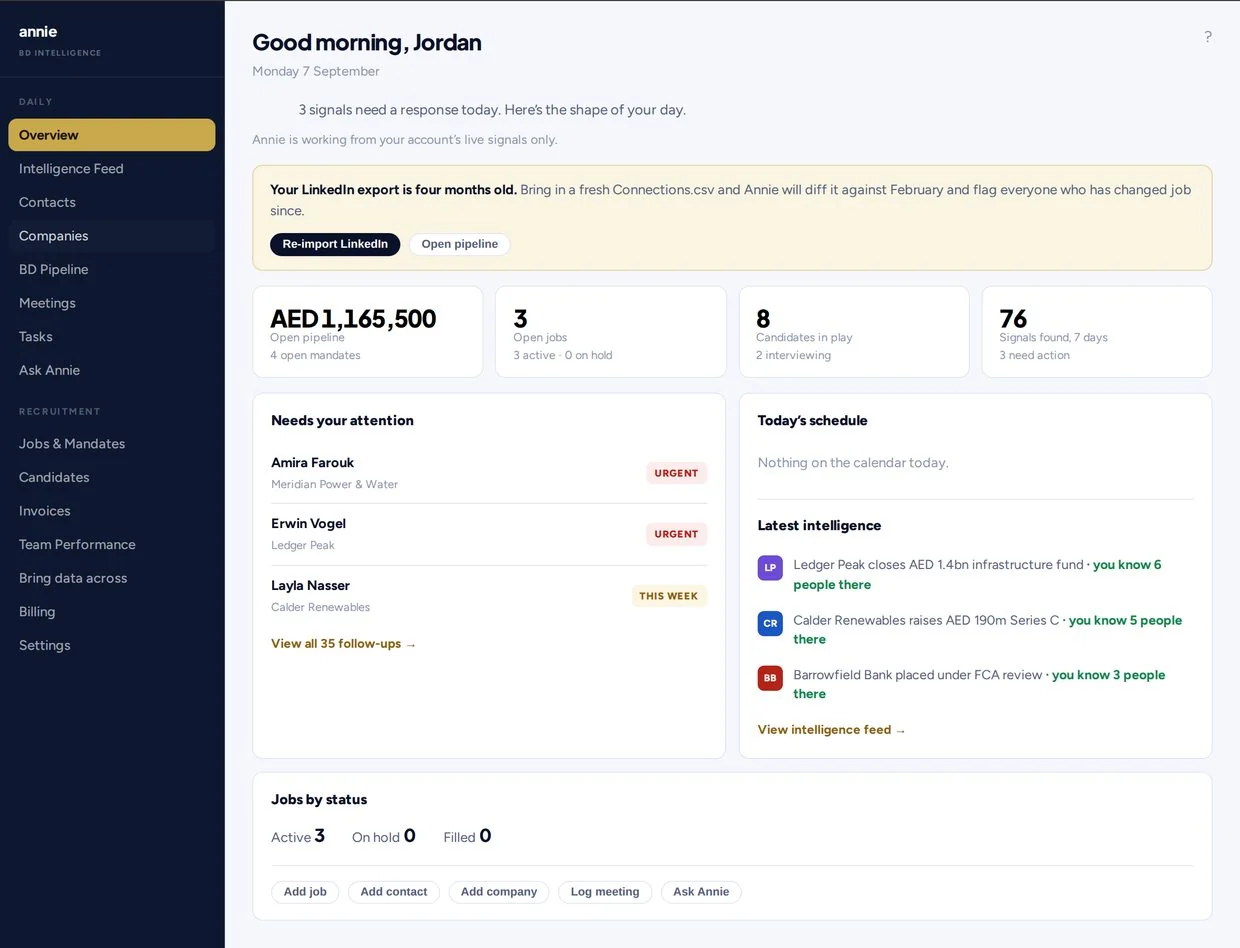
Here is how that plays out on one example desk. The names are example data.
Your call list opens on a leadership change. Meridian Sovereign has named a new Group General Counsel, and you know Layla Nasser there. The card says why now, links the announcement and suggests an opening line.
Before you call, you ask Annie what you last discussed with Meridian. She pulls it from your own timeline. You call, then tell Annie to log it.
Layla asks you to run the search. You open a mandate and put the terms in your custom fields. Then you ask Annie which of your candidates fit the brief. She lists the matches from your own database, with the reason for each.
You build the shortlist and send Layla a view-only link. When the placement lands, you raise the invoice and email it from the same desk.
Run the mandate in the same place
Delivery and business development feed each other more in search than anywhere else. Today's candidate is often tomorrow's client.
In Annie, drop in a CV and she fills in the candidate record for you to check. Search your candidates with Boolean strings. Open a mandate to see who in your own database fits, and why. Ask Annie about any client, candidate or company, even one that isn't in your CRM yet.
If a draft would help, ask for one. Annie writes the approach in your words, and nothing goes until you press send. In search, a clumsy message to the wrong person costs more than a slow one.
At the end of each week, Annie writes a short note on how your desk is running.
Built by a search recruiter
Annie was built by Michael Stubbs, a recruiter with nearly 15 years in GCC search. He built it for the desk he ran himself: a founder doing the business development and the delivery, working from a network built over years. If you want to talk it through with him, email the team.
A checklist for boutique search firms
Put any executive search software through these questions:
- Each mandate has its own pipeline, from long list to placement
- You can record your own mandate terms without a workaround
- Every document on a candidate stays on their record
- You can share a shortlist with a client without exporting a file
- It tells you when something changes at a company where you know someone, and links the source
- It works from your own network, not a list of strangers
- Nothing goes to a client or candidate unless you send it
- The price is one number you can read without booking a call
Pricing
Annie costs $159 a month for one recruiter. That covers the whole CRM, the daily call list, the market signals and 150 contact lookups a month. There is no setup fee and no minimum term. The trial runs for seven days and needs no card. After you pay, you keep access until the end of the period. No refunds, except where required by law. See Annie pricing for monthly and yearly options.
Questions
Yes. Each mandate is a job with its own pipeline, and custom fields hold the terms you agree, such as retainer stages. When the placement lands, you raise the invoice and email it from Annie.
Annie matches candidates from your own database when you open a mandate, and gives the reason for each. When you need contact details, 150 contact lookups a month are included.
No. Annie ranks who to call and drafts an approach when you ask. Every message goes from your own mailbox, and nothing leaves until you press send.
Keep it if it's working for you. Most tools are built around sending. Annie's job is knowing who to call. Every morning she reads your own network and your market, spots funding rounds and new appointments at companies where you know someone, picks up moves when you re-upload your LinkedIn file, and tells you who's worth a call and what to say. Run her alongside what you have, or use her as your whole CRM, with pipeline, candidates, placements and invoices included. $159 a month, 7-day free trial, no card, cancel any time.
Solo and boutique recruiters who do their own business development and delivery. That includes executive search founders who work from a network built over years.
$159 a month for one recruiter. The trial is seven days and needs no card. No refunds, except where required by law.